Edge command kit
MacBook, tablet, phone, drone, and radios operating as one local mission workspace.

Edge AI · Mesh · Mission Software
Not surveillance tracking for everyone outside it.
Local AI, mesh, and ATAK integration running on the team's own hardware. Sync to Lattice, Palantir, or command when the mission calls for it. Stay local when it does not. Wipe when the mission ends.
Data
LOCAL ONLY
SECURED
Mesh
TEAM ONLY
ENCRYPTED
AI
ON-DEVICE
NOMINAL
Mission
EPHEMERAL
WIPE READY
How It Works
What It Is
Devices, models, sensors, and mission records connected in one edge-controlled layer.
Plan, execute, and review from one operating picture. 10 role-specific views. 193 API endpoints. 89 mission components.
35 open-weight models across 5 categories. Object detection, segmentation, speech, reasoning, and embeddings. All on-device.
9 transport types. WiFi, BLE, LoRa, Starlink, Direct-to-Cell, LTE, MANET, Iridium SBD, USB-C Courier. Store-forward across all.
Classification-aware MDM. STIG compliance. Signed courier delivery. Device passport verification. Duress wipe.
Multi-Sensor Fusion
RF-DETR + YOLO ByteTrack tracking SAM segmentation Zone crossing
Drone motor (90-420 Hz) Gunshot classification Vehicle engine Speech-to-text
28+ TPMS protocols Passive vehicle ID WiFi/BLE correlation Emitter classification
3-factor IFF Face match + NFC + device Blood type from card Allergy flagging
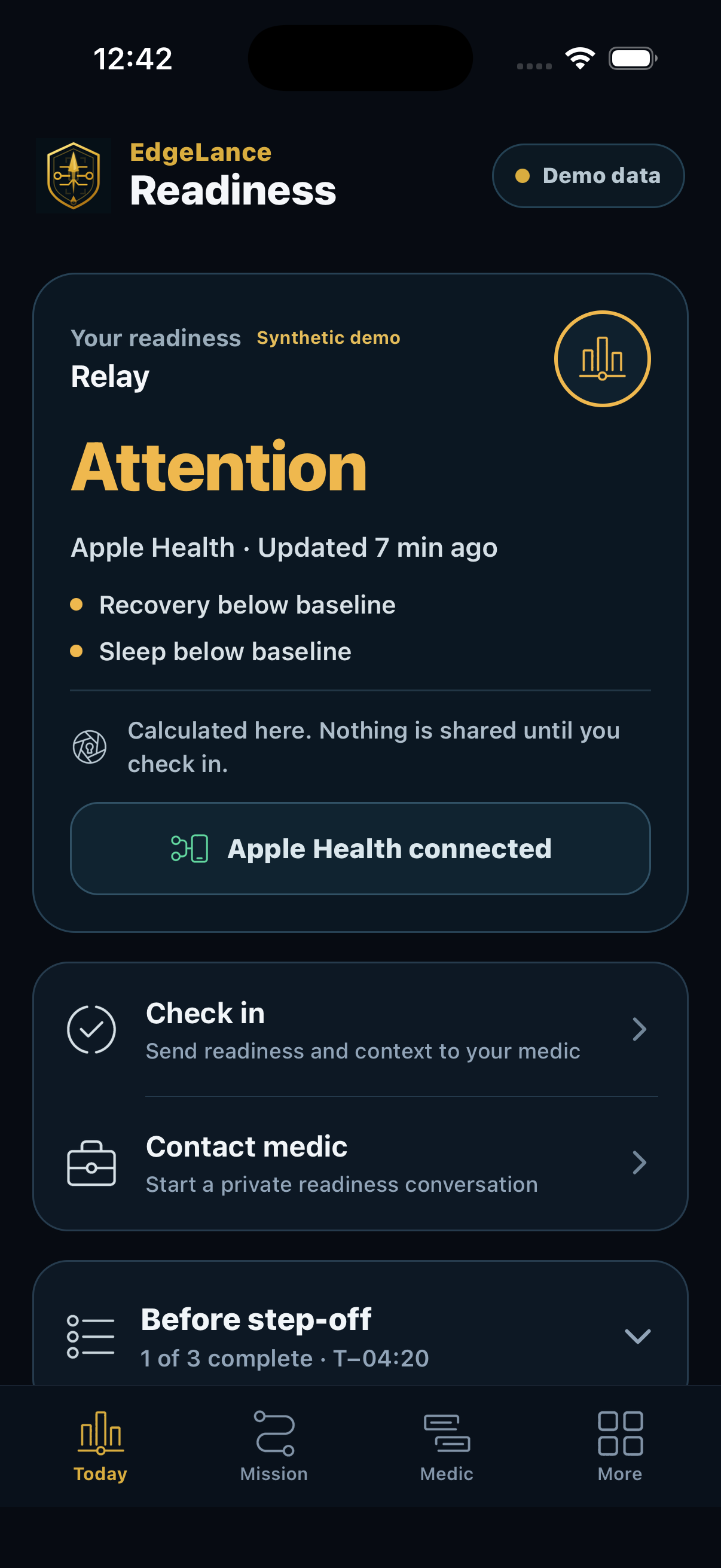
9 providers HR, HRV, SpO2, stress Sleep debt scoring Relief recommendation
Plate recognition Watchlist alerting RF cross-reference Vehicle track merge
Product Screens
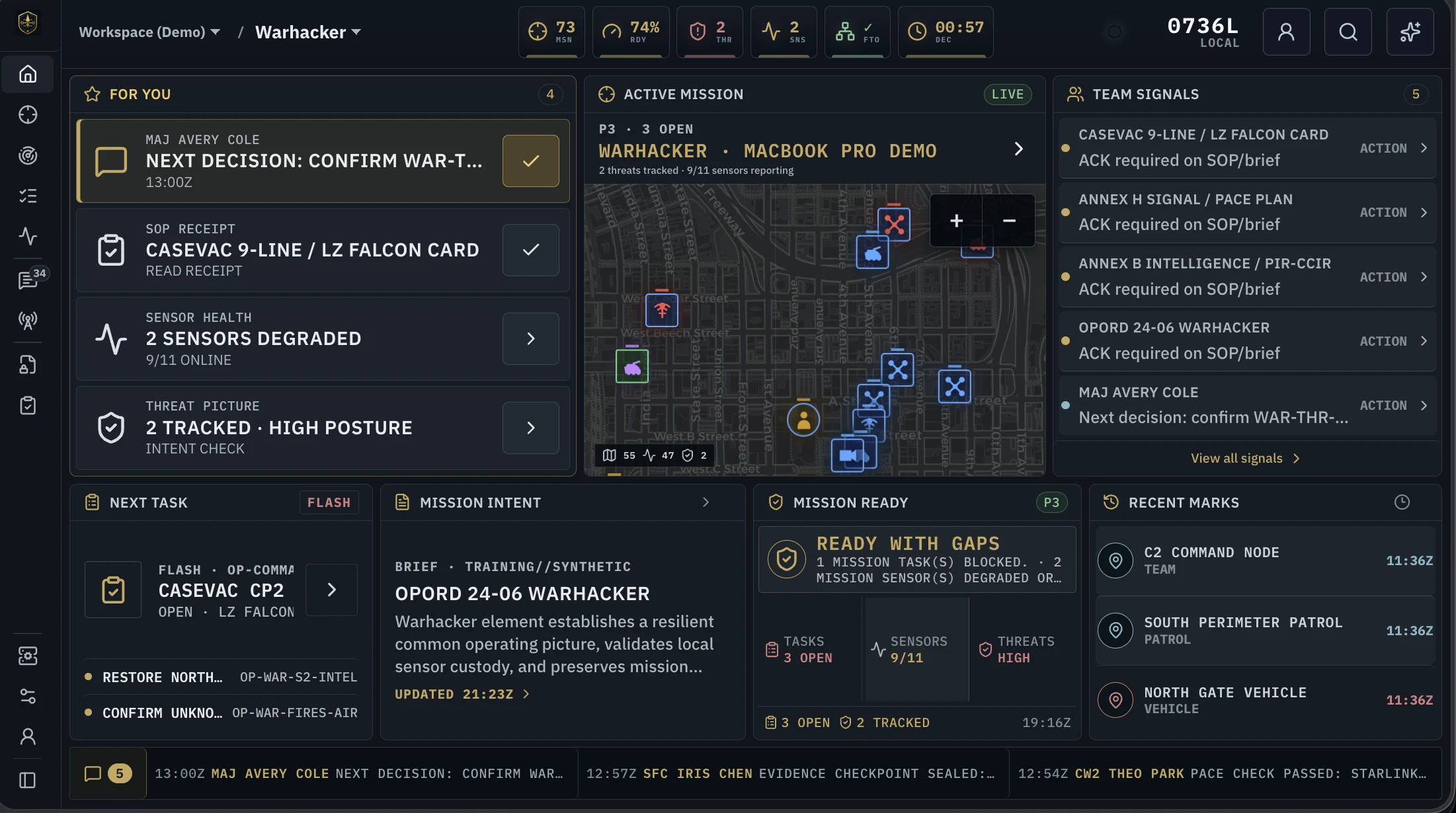
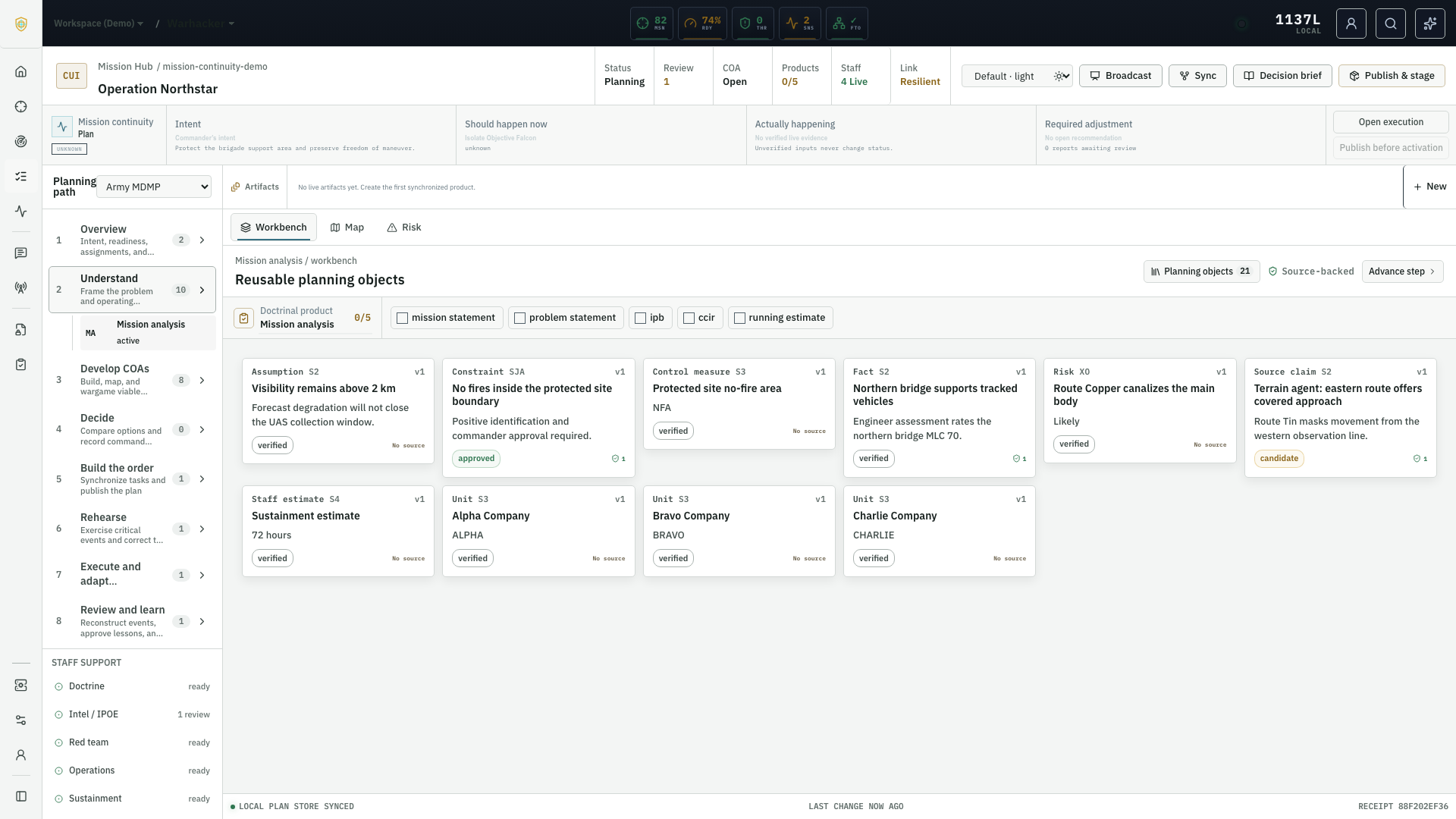
EdgeLance is built to be demonstrated as an operating system across laptops, phones, watches, cameras, drones, and mesh nodes.

Adaptive camera wall, contact continuity, local crop tagging, and map handoff from existing RTSP feeds.
Field Context
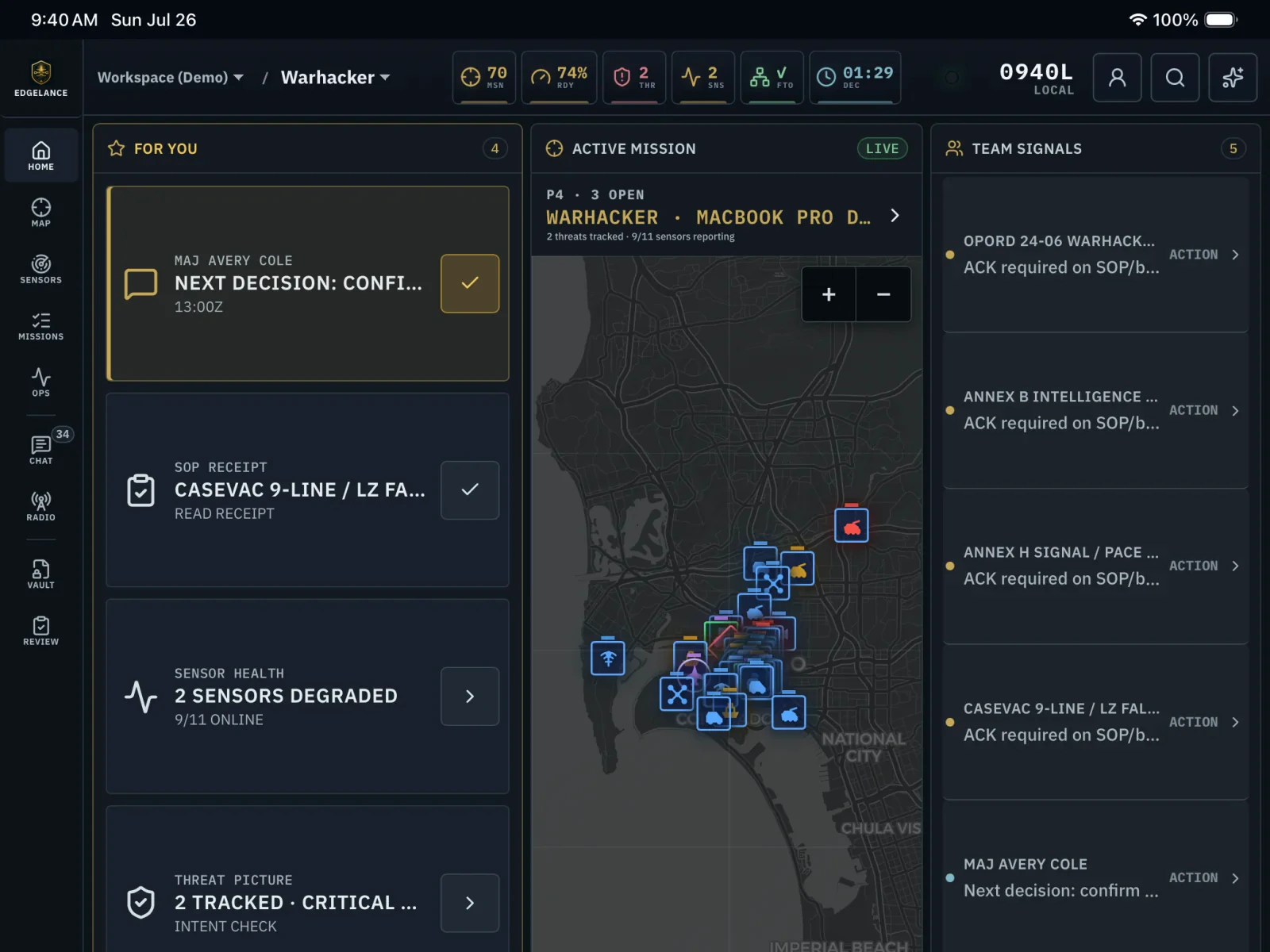
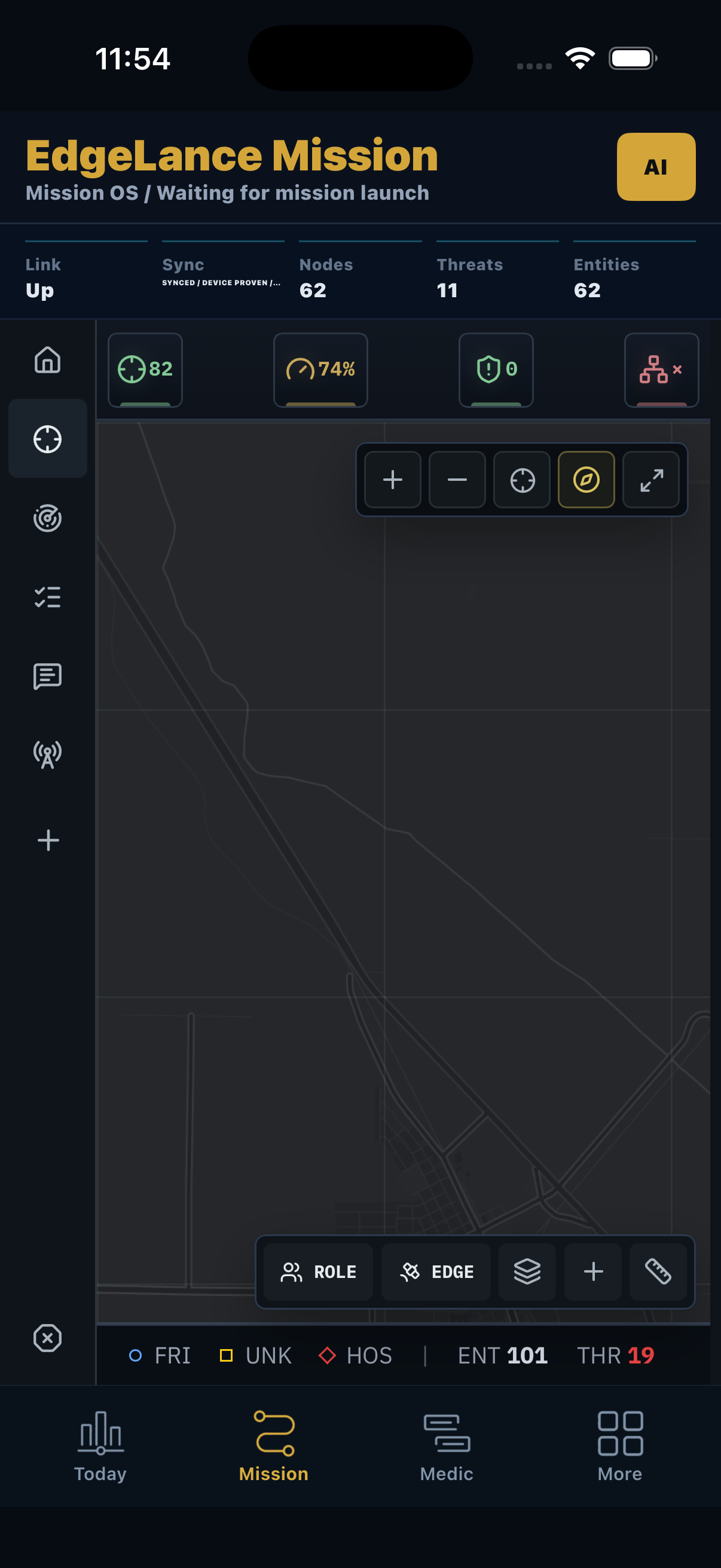
EdgeLance is meant to be seen as a mission kit: laptops, phones, tablets, wearables, cameras, drones, radios, and mesh relays carrying the same mission state.

MacBook, tablet, phone, drone, and radios operating as one local mission workspace.

Nodes keep sharing location, status, and alerts as links step down from IP to local mesh.

Medic and operator screens stay focused on the actions each role can take right now.
Mission Surfaces
Cycle through live operations, camera intelligence, contact tracing, fleet posture, model routing, mission packs, evidence, and after-action review.

Assets, zones, alerts, role status. Operators stay in one view.
Demo Story
Build the pack. Deliver it. Operate locally. Publish to ATAK. Wipe what should not persist.

01
Describe the mission. EdgeLance recommends models, files, apps, and per-device loadouts.

02
Live map, AI directive, camera tracks, readiness, and mesh status stay in one operator view.

03
Drones, cameras, laptops, phones, and relays share ISR through local mesh and store-forward sync.

04
Wrist, phone, and laptop actions give operators fast distress, check-in, and rally controls.
Security Is the Product
12 security gates. Fail-closed. Every gate passes before the system serves a request.
AES-256-GCM key destruction All AI outputs unrecoverable Proof chain survives
Silent wipe + decoy unlock Covert mesh alert to command MDM-enforced key destruction
API key, WS token, MQTT auth CORS, RBAC, TLS, signing Fail-closed in production
TS / SECRET / CUI per device STIG continuous compliance Device passport + trust score
Firmware provenance scoring Default credential detection Chinese IoT sinkholing
HMAC-SHA256 signed ledger Tamper-evident Survives mission burn
ATAK / iTAK native
EdgeLance processes drone feeds, wearable data, and sensor inputs locally, then publishes results as Cursor-on-Target. Operators see detections on the ATAK map they already trust. No data leaves the device.
CoT publishing
Detections, drone tracks, readiness, RF contacts, medical, and supply points appear as native ATAK markers.
Extends existing mesh
Adds local AI processing and delayed sync on top of existing mesh workflows. Full mission record available when comms resume.
Zero external data
All inference runs on Apple Silicon, NVIDIA, or approved edge hardware. Model weights stay local. Nothing phones home.
Secure by design
Classification-aware MDM, signed model loadouts, STIG compliance, and audit trails from device enrollment through mission review.
Integrations
Bidirectional CoT XML
Entity bridge, selective sync
Ontology export, no cloud dependency
P2P mesh sync, CRDT conflict resolution
Airgapped LLM via UDS/Zarf
LoRa mesh, $30/node, store-forward
Drone telemetry, waypoints, gimbal
9 transport profiles, auto-degrade
Signed delivery, wrong-device reject
Who It Helps
Operators
Tactical map, threat directives, sector assignment, NFC/face IFF challenge, sensor tasking, and burst comms. One screen.
Medics
5-casualty triage, blood type/allergies from NFC cards, CASEVAC 9-line, supply tracking, wearable vitals from 9 providers.
Command
Mission readiness score, ROE decision audit, CASEVAC approval, evidence-coupled AI with operator override, AAR generation.
Systems Teams
8-node fleet MDM, STIG compliance, signed courier delivery, model routing across 35 options, hardware trust interrogation.
Why It Is Different


Role-Specific Mission Views
Common mission picture. Different overlays, actions, and AI context per role.
Where It Is Useful
Cameras trigger event-based AI analysis, push concise alerts to the team, preserve clips locally, and sync evidence when bandwidth returns.
A medic sees casualty location, vitals, injury context, allergies, CASEVAC status, med supply, and command decisions in one view.
Phones, laptops, watches, drones, cameras, and relays keep sharing mission updates through local mesh and store-forward sync.
Policy can prefer a local NVIDIA server, then laptops, then phones, then approved cloud models depending on classification and link state.
Operator trust by design
AES-256-GCM mission key. Destroy it and every AI output, sensor event, and operator action across all nodes is gone. Proof chain survives for accountability.
Silent wipe with decoy unlock. Covert mesh alert to command. MDM-triggered key destruction. No other fielded system does this.
Every AI output links to the source sensor frame via SHA-256 hash. Operators challenge the recommendation, see the raw data, override or accept.
35 models across 5 categories. Pick per node during mission prep based on memory, mission, and connectivity. Swap models, not procurement cycles.
Why EdgeLance
Enterprise platforms serve brigade and above. Radios carry data but do not process it. EdgeLance fills the gap with AI, mesh, MDM, and evidence on hardware teams already carry.
Interoperability
Connects to enterprise platforms when the mission calls for it. The team controls what gets shared.
Link Adaptation
EdgeLance adapts payload, AI, evidence capture, and burn reach across every link condition. The system keeps working. The operator keeps control.
Cost Calculator
EdgeLance runs all AI inference on hardware you already own or can buy off the shelf. Object detection, vision analysis, transcription, segmentation, and threat narration execute locally at zero marginal cost per query. Replicating this through cloud APIs costs $15-25 per node per hour at budget pricing. At scale, it is hundreds of thousands per month.
Run the Numbers1 Node / Hour
$16-26
cloud API costs
EdgeLance
$0/hr
local inference
Battalion / Year
$5M+
cloud at 40 nodes
EdgeLance
$0/query
software license, your hardware
Live walkthrough: mission planning, local AI, ATAK integration, drone ISR, wearable readiness, and ephemeral mission lifecycle.
Schedule a Demo